B2B Contact Verification Standards
“Verified” should mean more than an email address passing an automated check.
At Verified Pipelines, our verification process combines structured data checks with human review to evaluate whether a B2B contact matches the targeting requirements agreed for a campaign.
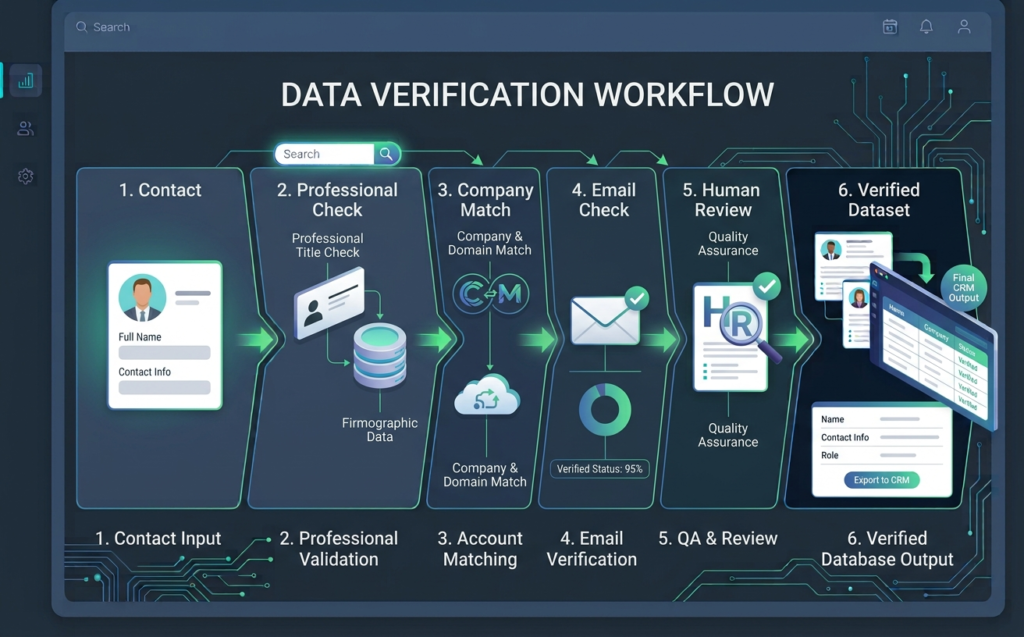
We review professional information, company relationships, domain details, email deliverability signals, duplicates, and targeting requirements before contacts are prepared for delivery.
Our goal is not simply to provide a large contact list. It is to provide relevant, reviewable B2B contact data that sales teams can use with greater confidence.
What Does a Verified B2B Contact Mean?
A verified B2B contact is a prospect record that has been evaluated against the agreed campaign criteria and passed the relevant professional, company, email, and quality checks available during the verification process.
Verification does not mean that a prospect is guaranteed to respond, become a customer, or purchase a product.
It means that the contact has been reviewed for data quality and targeting relevance according to the defined requirements.
Verification ≠ guaranteed sales
Contact verification improves the quality and usability of prospect data. It cannot guarantee replies, meetings, conversions, or revenue.
1. Professional Identity Verification
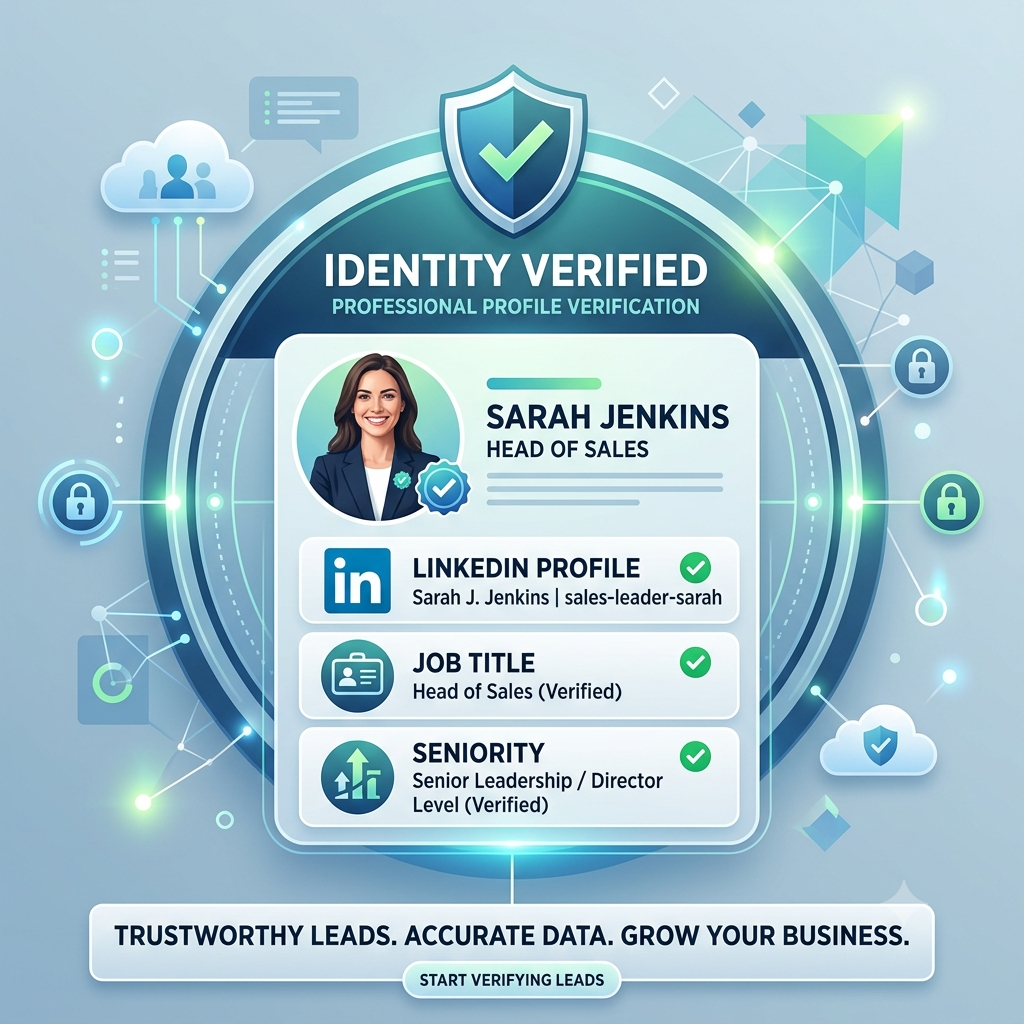
We evaluate the professional information associated with each contact to determine whether it matches the targeting requirements.
Depending on the campaign, this can include:
Job Title & Seniority
Job titles are reviewed against the agreed targeting criteria. Where appropriate, related titles may be considered when they represent the same decision-making function.
Current Company
We check whether the contact is associated with the company being targeted and whether the professional information is consistent with the requested account criteria.
2. Company and Domain Verification
A contact’s company information is an important part of B2B data quality. We review the relationship between the contact, company, and business domain to identify obvious mismatches before delivery.
Company Match
The contact should be associated with the company specified by the campaign targeting criteria.
Domain Match
The business email domain is reviewed against the relevant company or organization where applicable.
Target Account Match
The company itself is evaluated against the agreed targeting requirements such as industry, geography, or company profile.
3. Email Verification and Deliverability Checks
An email address can look valid while still being unsuitable for outreach. Our email verification process evaluates available deliverability signals before an address is included in the final dataset.
Syntax Check
Checks whether the email address follows a valid email format.
Domain Check
Checks whether the domain is correctly structured and capable of handling email.
Deliverability Signals
Available technical signals are evaluated to identify addresses that appear invalid or undeliverable.
Catch-All Detection
Catch-all domains are identified because they can accept messages for addresses that cannot be confirmed at the individual mailbox level.
What Email Verification Can — and Cannot — Tell You
Can help identify
Cannot guarantee
Email infrastructure can change after verification. A valid result is therefore a point-in-time assessment rather than a permanent guarantee of future deliverability.
4. Human Quality Review
Automated checks are useful for identifying technical problems, but they cannot evaluate every aspect of a prospect record.
Human review adds another layer of quality control by checking whether the record makes sense in the context of the campaign requirements.
Targeting Compliance
Does the contact fit the agreed ICP and targeting criteria?
Professional Relevance
Does the role make sense for the requested decision-maker profile?
Company Relevance
Does the contact belong to the intended target account?
Data Consistency
Are there obvious inconsistencies, duplicates, or mismatched fields?
5. Duplicate and Data Quality Checks
Duplicate records can reduce the usable value of a prospect list and create unnecessary repetition in a sales workflow.
Before delivery, records are reviewed for duplicate contacts and obvious data inconsistencies within the scope of the order.
✓ Duplicate contact review
✓ Company/contact mismatch review
✓ Job-title mismatch review
✓ Missing or inconsistent information
✓ Targeting requirement review
6. Verification Date and Data Freshness
B2B contact information changes over time. People change roles, companies update domains, and email addresses can become inactive.
For this reason, verification should be viewed as a point-in-time assessment rather than a permanent status.
We are introducing verification-date tracking as part of our ongoing data-quality improvements.
Understanding Verification Results
| Status | Meaning |
|---|---|
| Verified | Passed the applicable professional, company, email, and quality checks |
| Invalid | A relevant check identified a significant data or deliverability issue |
| Catch-All | The domain accepts mail for addresses that cannot be individually confirmed |
| Uncertain | Available signals are insufficient to establish a definitive result |
| Duplicate | The record duplicates another contact within the relevant dataset |
What Verification Does Not Guarantee
Verified Pipelines does not equate contact verification with sales qualification.
A verified contact may still:
Ignore an outreach message
Have no current interest in your product
Have changed roles after verification
Become unavailable
Fall outside your eventual buying criteria
Verification is designed to improve data quality and targeting, not guarantee commercial outcomes.
Responsible Use of Verified B2B Data
Contact verification and legal compliance are separate considerations. Verifying an email address does not by itself establish that a particular person can legally be contacted for a particular marketing purpose.
Customers are responsible for ensuring that their outreach practices comply with the laws and regulations applicable to their business, location, recipients, and communication method.
For example, UK guidance explains that business-to-business marketing can still involve personal data and that organizations using personal data for direct marketing need to consider applicable data-protection requirements.
In the United States, the FTC states that CAN-SPAM applies to commercial email, including B2B email, and sets requirements around matters such as accurate sender information and opt-out mechanisms.
Our B2B Contact Verification Standard
Our standard is built around five principles:
01 — Relevant
The contact should match the agreed targeting criteria.
02 — Current
Professional and company information should reflect the most recent information available during research.
03 — Deliverable
Email addresses are evaluated using available deliverability signals.
04 — Human-Reviewed
Automated checks are supplemented by human quality review.
05 — Transparent
We clearly distinguish between what verification establishes and what it cannot guarantee.
From Targeting Criteria to Verified Contacts
01 — Define ICP
You provide your target criteria.
02 — Research
Relevant companies and contacts are identified.
03 — Verify
Professional, company, domain, and email checks are performed.
04 — Review
The dataset receives human quality review.
05 — Deliver
The final prospect data is prepared for your sales workflow.
B2B Contact Verification FAQs
Want to Know Exactly What You’re Getting?
Tell us your target audience and we’ll explain how the verification requirements can be applied to your prospect list.
Learn more about the principles behind our approach on our Why Verified Pipelines page.