Verified B2B Data vs. Scraped Lead Lists
Not every contact found online is ready for sales outreach. Learn what separates a scraped contact list from B2B data that has been targeted, researched, verified, and reviewed before delivery.
How We Verify Contacts
View Pricing
Scraped Data Isn’t the Same as Sales-Ready Data
B2B prospecting often begins with collecting information from multiple sources. Scraping can help gather names, companies, job titles, domains, and email addresses at scale, but collecting a record does not necessarily mean the record is accurate, relevant, or ready for outreach.
A useful prospect record needs to satisfy several conditions at the same time. The company should fit the intended market, the person should match the required role, the professional information should be current, and the email address should be evaluated for deliverability.
That’s where verification and quality control become important.
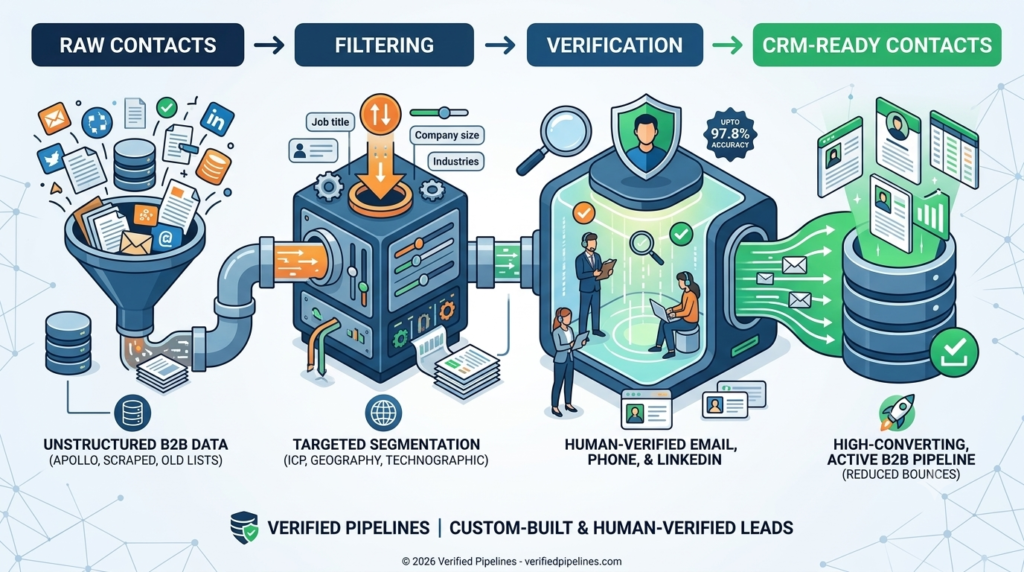
At Verified Pipelines, we approach B2B contact data as a research and verification process, rather than simply a collection exercise.
Verified B2B Data vs. Typical Scraped Lists
Data quality factor | Verified B2B data | Typical scraped list |
|---|---|---|
ICP targeting | ✔️ Targeted to defined criteria | Varies |
Industry targeting | ✔️ | Varies |
Geographic targeting | ✔️ | Varies |
Decision-maker targeting | ✔️ | Varies |
Job title verification | ✔️ | Varies |
Company/domain matching | ✔️ | Varies |
Email deliverability checks | ✔️ | Varies |
Catch-all handling | ✔️ | Varies |
Human quality review | ✔️ | Often limited |
CRM-ready delivery | ✔️ | Varies |
Replacement policy | ✔️ | Depends on provider |
The difference isn’t simply how many contacts can be collected. It’s how much confidence you can have in the contacts before they reach your sales workflow.
Identify the Right Decision-Makers
Finding someone who works at a target company isn’t enough if their role doesn’t match the intended audience.
Professional information is therefore checked against the customer’s requirements, including the person’s job title and relationship with the company.
This helps reduce common data mismatches such as outdated titles, incorrect departments, or contacts who don’t fit the intended decision-maker profile.
Verify the Person, Company, and Domain Match:
Person
Contact data becomes significantly less useful when the person, company, and email domain don’t correspond.
Company
We check the professional information associated with the contact and verify that the job title and company relationship align with the target requirements.
Domain
This additional review helps identify records where a contact may have changed companies, moved into a different role, or been associated with an incorrect domain.
Evaluate Email Deliverability:
An email address that looks correctly formatted isn’t necessarily an email address that can receive messages.
Email deliverability testing can evaluate whether the address appears valid, whether the destination can accept mail, and whether the domain behaves like a catch-all or accept-all domain.
This distinction matters because sales teams don’t simply need an email address — they need an address that is appropriate for outreach.
Email deliverability also depends on factors beyond the individual address, including domain configuration and sender practices. Google’s email sender guidelines provide additional information for organizations sending email to Gmail users.
Invalid
Lorem ipsum dolor sit amet, consectetur adipiscing elit. Aenean diam dolor, accumsan sed rutrum vel, dapibus et leo.
Reachable / Valid
The address passes available mailbox-level checks.
Catch-all / Accept-all
The domain accepts email for addresses that may not correspond to a confirmed individual mailbox.
What Is a Catch-All Email Domain?
A catch-all, also called an accept-all domain, is configured to accept email for multiple addresses even when a specific mailbox may not actually exist.
This creates an important limitation for email verification: a successful technical response from the domain does not necessarily prove that a particular person’s mailbox exists.
For that reason, catch-all domains require additional caution when assessing contact quality.
Some domains can also behave differently during verification attempts, making them harder to classify with a simple valid/invalid test. Treating every successful response as proof of a verified individual mailbox can therefore create a false sense of confidence.
Learn more about our approach to email and catch-all verification →
Add Intent-Based Targeting When Required:
Some campaigns need more than company and job-title targeting.
For customers who require intent-based targeting, we can use up to four customer-provided keywords to identify prospects that may be more closely aligned with a specific topic, need, product category, or business objective.
Intent targeting is optional and is used when it adds value to the customer’s prospecting requirements.
Human Review Before Delivery:
Automated checks can identify many data-quality issues, but they don’t replace human judgment.
After the research and verification stages, the dataset undergoes a human quality review before delivery.
The purpose is to catch mismatches and inconsistencies that may not be apparent from an individual data field alone.
This final review helps ensure that the delivered dataset aligns with the customer’s original targeting requirements.
Research → Verify → Test → Review → Deliver
Receive CRM-Ready B2B Contact Data:
Once the quality review is complete, the contacts are exported into a structured dataset and delivered as CRM-ready CSV data.
This allows sales teams to move from prospect research to their existing workflow without manually restructuring every record.
✓ Structured contact data
✓ Company information
✓ Professional information
✓ Email information
✓ Targeting fields
✓ CRM-friendly CSV format
Our Replacement Policy:
Data quality matters even after delivery. If a customer identifies a contact that does not meet the agreed requirements, contains a relevant data mismatch, or results in an email bounce, the contact can be submitted for review under our replacement policy.
We review the reported record against the original targeting and verification requirements.
Replacement applies to qualifying issues such as incorrect professional information, relevant data mismatches, or confirmed email bounces, subject to our review.
We don’t treat every negative outreach outcome as a data-quality failure. For example, a prospect not responding to an email does not mean the contact information was incorrect.
This distinction helps keep the replacement policy focused on verifiable data-quality issues rather than sales outcomes.
Why Not Just Scrape the Contacts Yourself?
Scraping can be useful when the objective is to collect information at scale. The challenge begins after the information has been collected.
A raw dataset may still contain:
- Contacts outside the target market
- Outdated job titles
- Incorrect company associations
- Duplicate records
- Incorrect or unusable email addresses
- Catch-all domains
- Contacts who don’t match the intended decision-maker profile
Cleaning and verifying these records requires additional research and quality control.
For companies that already have the infrastructure and resources to perform this work internally, scraping may be an appropriate part of their workflow.
For sales teams that would rather spend that time on prospecting and selling, an externally researched and verified dataset can reduce the manual work between finding a lead and being ready to contact them.
Who Can Benefit From Verified B2B Data?
Sales Teams
Build targeted prospect lists without spending hours researching individual contacts.
B2B Agencies
Support client campaigns with research and contact data aligned to specific targeting requirements.
Founders & Small Businesses
Build an outbound prospecting database without maintaining a large internal research operation.
Revenue Teams
Supplement existing prospecting workflows with externally researched and verified contact data.
Build a More Reliable B2B Prospecting List:
The quality of your prospecting starts with the quality of your data.
If you’re looking for targeted B2B contacts researched around your specific customer profile, explore how Verified Pipelines approaches contact verification and data quality.
See How We Verify Contacts