How We Verify B2B Contacts
Verified B2B data starts with more than finding a name and an email address.
At Verified Pipelines, every contact is researched against your Ideal Customer Profile, checked for role and company relevance, evaluated for email deliverability, and reviewed by a human before delivery.
Our goal is simple: deliver CRM-ready B2B contacts that match your targeting requirements and are ready for sales outreach.
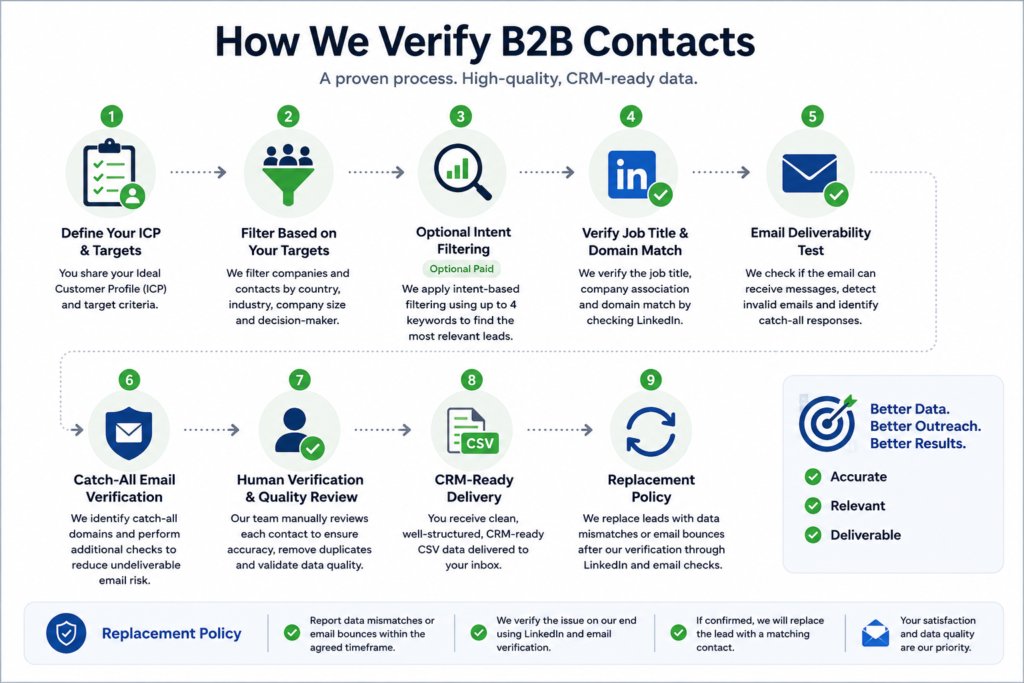
Our B2B Contact Verification Process:
1. We Start With Your Ideal Customer Profile
Every project begins with your Ideal Customer Profile (ICP).
You provide the criteria that define the companies and decision-makers you want to reach. This can include:
- Target countries
- Industries
- Company size
- Decision-maker roles
- Job titles
- Other company or contact requirements
The more specific your targeting criteria, the more accurately we can build your contact list.
We don’t simply provide a large database of contacts. We build the list around your specific sales criteria.
2. We Filter Companies and Contacts Based on Your Target
Once your targeting requirements are established, we narrow the research to contacts that match your criteria.
We evaluate factors such as:
Geography: Is the company located in your target country or market?
Industry: Does the company operate in the industry you are targeting?
Company profile: Does the organization meet your required company characteristics?
Decision-maker: Does the contact hold the type of position you want to reach?
This filtering process helps remove contacts that may look relevant at first glance but don’t actually fit your target market.
3. Optional Intent-Based Targeting
For customers who want more targeted prospecting, we also offer an optional intent-based filtering service.
You can provide up to four keywords related to the products, services, technologies, problems, or topics you want your target audience to be associated with.
These keywords are then used as additional targeting criteria during research.
This can help narrow a broad audience into a more specific prospect segment.
Example:
Instead of targeting every company in a particular industry, you may want companies associated with keywords related to:
- Sales automation
- Customer relationship management
- Financial reporting
- Marketing automation
Intent-based targeting is optional and available as an additional paid service.
4. We Verify the Job Title and Company Association
Finding a person’s name is not enough.
A contact needs to be associated with the right company and the right role.
We manually check the contact’s professional profile to confirm that:
- The person is associated with the specified company.
- The job title matches the required position.
- The company domain corresponds with the organization being targeted.
- The contact meets the customer’s requested decision-maker criteria.
This step helps prevent common data problems such as outdated job titles, incorrect company associations, and contacts that no longer match the requested role.
5. We Test Email Deliverability
An email address can look perfectly valid while still being unsuitable for outreach.
That’s why email deliverability is evaluated separately from contact and job-title verification.
During the email verification process, the receiving mail server can be checked to determine whether the domain exists, whether the mail system is configured to receive email, and whether the specific mailbox can be validated.
Depending on how the receiving server responds, an email address may be classified as:
- Valid / deliverable — the mailbox appears capable of receiving email.
- Invalid — the address or domain does not appear capable of receiving the message.
- Catch-all / accept-all — the domain accepts mail for addresses that cannot be individually confirmed.
- Risky or uncertain — the receiving server does not provide enough information to confidently determine mailbox status.
How Email Verification Works
Email verification does not necessarily send a normal email to the recipient.
Instead, technical checks can examine several parts of the email infrastructure.
First, the email domain is checked to determine whether it exists and has an operational mail server.
The receiving mail server can then be queried to determine how it handles the address. In some cases, the server provides enough information to indicate whether the mailbox exists. In other cases, the server deliberately hides this information or accepts all addresses.
This distinction is important because an email address being syntactically correct does not mean that the mailbox actually exists.
For example:
john@company.com
may have a correctly formatted address and a valid company domain, but that alone doesn’t prove that the mailbox john@company.com exists.
Our verification process therefore considers the available technical response rather than relying only on the format of the email address.
What Is a Catch-All Email Domain?
A catch-all, also called an accept-all domain, is a domain configured to accept email for multiple addresses—even when the specific mailbox cannot be independently confirmed.
For example, imagine a company domain:
company.com
A normal mailbox might be:
john@company.com
If the domain is configured as catch-all, an address such as:
randomname123@company.com
may also be accepted by the receiving mail server.
That creates an important problem for email verification.
The server may effectively say:
“We accept mail for this domain.”
But that does not necessarily mean the specific person’s mailbox exists.
Therefore, a catch-all result should not automatically be treated as equivalent to a confirmed individual mailbox.
Why Some Domains Behave Differently During Verification
Some organizations deliberately configure their mail servers to provide limited information about individual mailboxes.
This can be done for security, privacy, anti-spam, or infrastructure reasons.
As a result, an email verification system may receive a response that does not clearly confirm whether a particular mailbox exists.
In some cases, domains may also be configured in ways that make them appear to accept all addresses during automated verification.
This is why catch-all verification requires additional caution.
Rather than treating every accepted server response as proof that an individual mailbox exists, we separate catch-all results from addresses that can be more confidently verified.
6. We Evaluate Catch-All Domains Carefully
Catch-all domains are not automatically bad.
A legitimate company can have a properly configured catch-all mail system.
However, because the individual mailbox cannot always be confirmed through a standard SMTP-level verification process, these contacts carry greater uncertainty than an individually verifiable mailbox.
We therefore identify catch-all results separately instead of presenting them as unquestionably verified individual email addresses.
This provides greater transparency about the quality of the data being delivered.
7. Every Dataset Goes Through Human Quality Verification
Automated checks are useful, but they cannot understand every data mismatch.
Before the final dataset is delivered, the collected contacts undergo a human quality review.
The review checks whether the records meet the requested criteria and looks for issues such as:
- Incorrect company
- Incorrect job title
- Company/contact mismatch
- Incorrect country or market
- Duplicate records
- Missing or inconsistent information
- Records that don’t meet the customer’s targeting requirements
This additional review is an important part of our quality-control process.
Our objective isn’t simply to produce a file containing thousands of rows.
It’s to produce a dataset that is useful for your sales and marketing workflow.
8. Your Contacts Are Delivered CRM-Ready
After verification and quality control are complete, the final contacts are organized into a structured CRM-ready CSV file.
The data can then be imported into your CRM, sales platform, or outreach workflow.
The final delivery is sent to you by email.
Depending on your project requirements, the dataset can contain relevant fields such as:
- First name
- Last name
- Job title
- Company
- Company domain
- Business email
- Location
- Industry
- Other agreed-upon data fields
The exact fields depend on your order and targeting requirements.
Our Replacement Policy
We take data quality seriously, but no verification process can guarantee that business information will remain unchanged indefinitely.
People change jobs. Companies change domains. Mailboxes can be disabled. Email infrastructure can also change after a dataset has been delivered.
Our replacement policy is therefore designed to address verifiable data-quality issues.
If you identify a contact that does not meet the agreed targeting criteria, you can report it to us for review.
For more information about our replacement policy click here
We consider replacement requests for issues such as:
- Incorrect job title
- Incorrect company association
- Data that does not match the agreed targeting criteria
- A business email that subsequently bounces
How Replacement Requests Are Reviewed
We don’t automatically replace every record reported by a customer.
To maintain a fair and consistent quality standard, we independently review the reported contact.
For job-title or company mismatches, we verify the information against the contact’s professional profile and the relevant company information.
For email-bounce claims, we independently recheck the email’s deliverability.
If our review confirms that the contact contains a qualifying data mismatch or that the email address meets the agreed replacement criteria, we will replace the affected lead.
This approach helps ensure that replacement decisions are based on independently verifiable information rather than subjective assessments.
Why Our Verification Process Matters
A large contact database isn’t necessarily a high-quality sales database.
Thousands of contacts that don’t match your ICP can create more work for your sales team instead of creating more opportunities.
Our process is designed around four principles:
Accuracy
Contacts should match the targeting requirements you provide.
Relevance
The company, industry, geography, and decision-maker should be relevant to your campaign.
Deliverability
Email addresses should be evaluated for their ability to receive email, with catch-all and uncertain results identified appropriately.
Human Quality Control
Automated verification is supplemented with human review before the final dataset is delivered.
From Your ICP to CRM-Ready Data
Your ICP → Targeting → Optional Intent Filtering → Job & Company Verification → Email Deliverability Check → Catch-All Evaluation → Human Quality Review → CRM-Ready CSV
That’s the process we use to turn a targeting requirement into a sales-ready B2B contact dataset.
Better targeting starts with better data.