Human-Verified B2B Contacts vs Database Leads: What’s the Difference?
In B2B sales, having a large contact list doesn’t necessarily mean you have a useful prospecting list.
The real question is simple:
Are the contacts accurate, relevant to your ideal customer profile (ICP), and ready for your sales team to use?
This is where human-verified B2B contacts can differ from contacts taken from large databases or aggregated sources.
In this article, we’ll look at the difference between the two approaches, how human verification works, and why data quality matters when building an outbound prospecting list.
What Are Human-Verified B2B Contacts?
Human-verified B2B contacts are contacts that have been manually researched and checked against specific targeting requirements before they are delivered.
Depending on the project, verification can include checking:
- Job title and seniority
- Company and industry
- Company size
- Geographic location
- LinkedIn profile
- Business email address
- Other ICP-specific requirements
The goal isn’t simply to collect contact information. It is to make sure the person and company match the criteria the customer actually needs.
This additional research can help sales teams spend less time cleaning lists and more time working with relevant prospects.
How Human Verification Works at Verified Pipelines
At Verified Pipelines, the process starts with the customer’s Ideal Customer Profile(ICP) rather than a generic database.
1. Define the ICP
The customer provides the criteria for the campaign, such as industry, company size, geography, job function, seniority, technology requirements, and other targeting preferences.
2. Research Potential Companies and Contacts
We identify companies and decision-makers that match the agreed targeting criteria.
3. Verify Email Deliverability
Business email addresses go through an email verification process to identify addresses that are suitable for outreach.
4. Give Additional Attention to Catch-All Addresses
Catch-all or accept-all domains can be difficult to verify with the same level of certainty as standard addresses. These contacts receive additional checking rather than automatically being treated as verified.
5. Verify the LinkedIn Profile
The contact’s professional profile is checked against the person’s role and the targeting requirements to help confirm that the right decision-maker has been identified.
6. Enrich and Prepare the Data
Once the research and verification process is complete, the contacts are enriched and delivered in a CRM-ready CSV format.
The result is not simply a larger list. It is a list built around the customer’s specific requirements.
What About Database Leads?
Large B2B databases can be useful for discovering companies and potential contacts at scale. They provide access to large volumes of information quickly and can be valuable during the early stages of prospecting.
However, database data can vary significantly in freshness, accuracy, and relevance.
Data quality goes beyond the size of a contact database. Accuracy, completeness, freshness, and relevance of B2B data all play a role in determining whether a B2B data is actually useful.
People change jobs. Companies change their structures. Job titles change. Email addresses become inactive. And a contact that matched your requirements six months ago may no longer be the right person today.
The important distinction isn’t necessarily database vs. human research.
It is what happens to the data before it reaches your sales team.
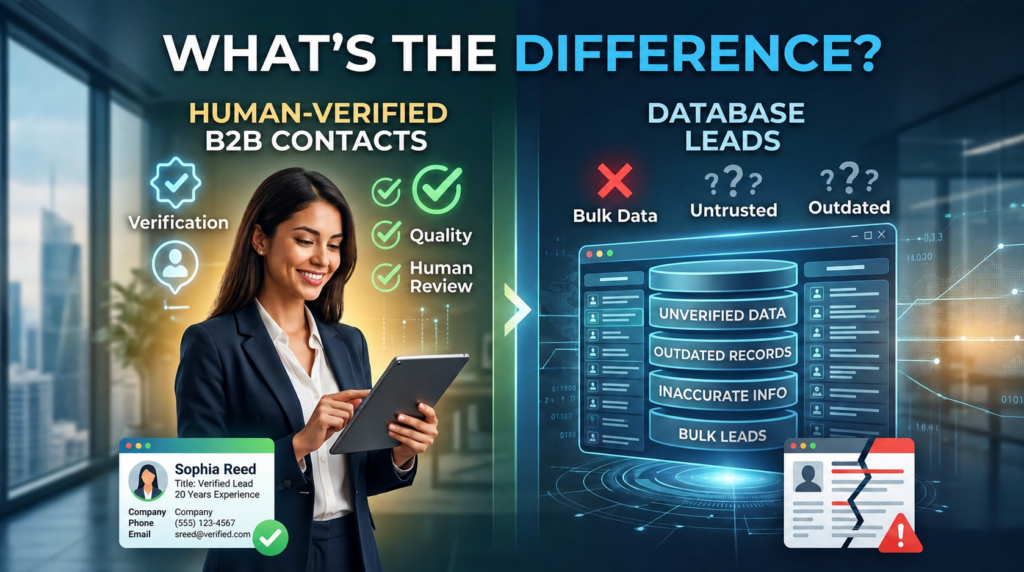
Database Data vs. Human-Verified Contacts
| Traditional Database Approach | Verified Pipelines Approach |
|---|---|
| Large pool of contacts | Contacts selected against the customer’s ICP |
| Automated or aggregated data | Additional research and verification |
| Email status may vary | Email deliverability is checked |
| Catch-all addresses may remain uncertain | Catch-all addresses receive additional checking |
| Limited context | Lead enrichment |
| Contact may not match the intended person | LinkedIn profile verification |
| Generic export | CRM-ready CSV |
Neither approach is automatically right or wrong. The difference comes down to the level of research, verification, and targeting applied to the data.
Common Problems With Unverified Prospect Lists
Outdated Information
People frequently change companies, roles, and responsibilities. A static contact record can become outdated without the database necessarily reflecting that change immediately.
Generic Targeting
A contact may have the right-sounding job title but work at a company that doesn’t fit your actual ICP.
For example, targeting “VP of Sales” alone doesn’t tell you whether the company is in the right industry, geographic market, size range, or technology segment.
Email Deliverability Problems
Sending campaigns to invalid or unsuitable email addresses can result in bounces and negatively affect your sending reputation.
That’s why email verification should be part of a broader data-quality process rather than treated as an afterthought.
Irrelevant Contacts
Even a valid business email isn’t useful if the person isn’t the right decision-maker for your product or service.
A smaller list of relevant contacts can be more useful than a much larger list that requires extensive manual cleaning.
Why Human Verification Matters
The value of human verification isn’t simply that a person looked at a contact.
It is the combination of research, targeting, verification, and context.
Better Alignment With Your ICP
Contacts are selected according to the criteria that matter to your business rather than simply matching a broad job-title search.
Less Time Spent Cleaning Data
Your sales team can spend less time removing irrelevant contacts, checking job titles, and investigating whether people still work at the target company.
Better Data Hygiene
Verification can reduce the risk of inaccurate or irrelevant information entering your sales workflow. However, no verification process can guarantee that business information will remain accurate indefinitely.
More Relevant Outreach
When you know who you’re contacting and why they fit your ICP, it becomes easier to personalize your messaging around the prospect’s role, company, and business context.
A More Usable Sales List
A CRM-ready, enriched list gives sales teams a practical starting point for their outreach rather than another database that needs to be cleaned first.
Should You Abandon Databases Completely?
Not necessarily.
In fact, many businesses can benefit from combining database research with human verification.
A database can provide a broad pool of potential companies and contacts. Human research can then be used to refine that pool, verify important information, prioritize the right decision-makers, and prepare the final list for outreach.
This hybrid approach can be particularly useful when a sales team needs both scale and quality.
The right approach ultimately depends on your budget, sales process, ICP, and how much manual research your team can realistically handle.
You can also review our B2B contact plans and pricing to see which option fits your requirements.
Final Thoughts
The real difference between human-verified B2B contacts and database leads isn’t simply human vs. database.
It’s about data quality and what happens before the contacts reach your sales team.
A large database may give you thousands of potential contacts. A human-verified research process focuses on identifying the contacts that actually fit your requirements, checking important information, and delivering the data in a format your team can use.
For businesses that care about targeted outreach, cleaner prospecting lists, and better data hygiene, that additional layer of research can make a meaningful difference.
Want to evaluate the quality before committing to a package? Request a free 10-contact sample from Verified Pipelines.
At Verified Pipelines, we focus on building human-researched, LinkedIn-verified, and email-verified B2B contacts around each customer’s specific ICP.
Quality contacts. Confident outreach.
Your free sample lets you evaluate the quality of our research before committing to a paid package.